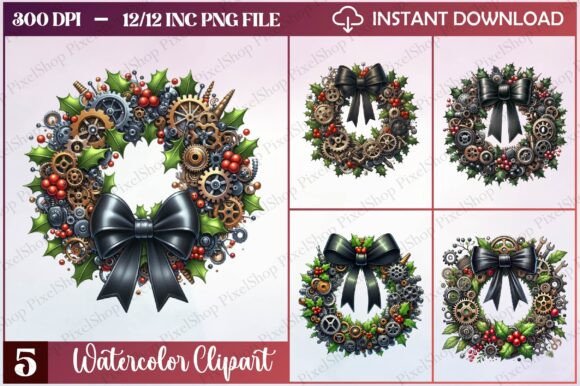
Watercolor Mechanical Berries Clipart Freebies Review
As a graphic designer constantly sourcing assets for boutique clients and handmade brands, finding the right balance between organic warmth and structured precision is often a challenge. When I first opened the Watercolor Mechanical Berries Clipart files for a recent rebranding project, my immediate impression was one of sophisticated contrast. This is not your standard botanical illustration. Instead of soft, flowing vines, these berries possess a geometric rigidity that feels intentional and modern. The watercolor texture provides the necessary human touch, preventing the mechanical aesthetic from feeling cold or industrial. For designers working in the creative marketplace space, this specific visual tension makes the asset incredibly versatile for clients who want to appear both artisanal and professionally established.
Elevating Brand Identity and Packaging Concepts
In my current case study, I am developing a visual identity for a small business specializing in sustainable tech accessories. The client needed marketing visuals that communicated eco-friendliness without relying on cliché leaf motifs. The Watercolor Mechanical Berries Clipart served as the perfect anchor for this brand identity. Because the shapes are stylized and slightly abstract, they function beautifully as secondary logo marks or repeating patterns on packaging design. I utilized the larger berry clusters as hero graphics on product boxes, where the watercolor bleeding at the edges softened the hard lines of the packaging die-cut. For Etsy product listings, this clipart adds a layer of perceived value; it signals to the buyer that the brand has invested in custom-feeling design assets rather than generic stock vectors.
Performance Across Digital and Print Mediums
A true test of any graphic design asset is its adaptability across different formats. In my workflow, I tested this digital product extensively for both screen and print applications. For social media graphics, specifically Instagram carousels and Pinterest pins, the high-contrast nature of the mechanical berries ensures they remain legible even when scaled down for mobile viewing. The distinct silhouettes work exceptionally well as background elements in Canva template designs, providing texture without competing with headline text. On the physical side, this asset shines in print-on-demand applications. I ran test prints for t-shirt design and tote bags, and the watercolor gradients translated smoothly without banding, provided the source file resolution was maintained. For Cricut project users and crafters, the defined edges make this ideal for sticker design or vinyl cutting, as there is minimal ambiguity in the shape boundaries compared to traditional, soft-edged watercolor paintings.
Strategic Placement: Where This Asset Thrives
Through practical application, I have identified specific environments where Watercolor Mechanical Berries Clipart elevates the final output. It performs best in large layout areas where the intricate details of the mechanical joints and watercolor washes can be appreciated. It is an excellent choice for:
- Editorial Design: Use as drop caps or section dividers in magazines or blogs focusing on modern crafting or tech-lifestyle niches.
- Product Mockups: Overlaying these berries on blank stationery or apparel mockups creates an instant lifestyle context.
- Seasonal Campaigns: The berry motif naturally suits autumn and winter collections, while the mechanical aspect keeps it relevant for year-round tech or maker brands.
- Web Design: Effective as footer accents or sidebar decorations where vertical space allows for the full stem length.
The asset also supports visual hierarchy effectively. Because the forms are self-contained, they guide the eye toward central content without creating visual noise. For small business branding, this means you can add decorative flair to invoices, thank-you cards, and email signatures without sacrificing readability or professionalism.
Navigating Limitations and Visual Hierarchy
However, professional judgment requires acknowledging where an asset should not be used. Watercolor Mechanical Berries Clipart demands breathing room. I advise against using this in crowded layouts or complex backgrounds where the watercolor transparency might get lost. It struggles in minimalist corporate environments that require stark, flat vector aesthetics; the texture here is a feature, not a bug, and removing it defeats the purpose. Furthermore, avoid placing this clipart directly behind body copy. The varying opacity of the watercolor washes can severely impact accessibility and text contrast. In logo design, use these elements as supporting illustrations rather than the primary logomark, as the fine mechanical details may disappear when scaled to favicon size. Always prioritize modern design principles of negative space to let the unique fusion of botany and machinery stand out.
Essential Pre-Flight Checks for Commercial Use
Before integrating this design bundle into a paid client project, I run through a rigorous quality assurance checklist. As professionals, we cannot assume a freebie is ready for production straight out of the zip file. Here are the critical steps I recommend for ensuring this clipart meets commercial standards:
- Verify Licensing: Even if labeled as free, always confirm the commercial license terms. Ensure you are permitted to use the asset in client work, POD products, or digital templates for resale.
- Test Transparency: Open the PNG design files on both white and dark gray backgrounds. Check for jagged edges or white halos that indicate poor masking. Clean up any artifacts in Photoshop before delivery.
- Contrast Validation: Convert the artwork to grayscale. If the mechanical berries vanish against the background in black and white, the color contrast is likely insufficient for accessible web design.
- Typography Pairing: Test the clipart alongside your chosen fonts. The mechanical nature pairs surprisingly well with clean sans-serif typefaces for a contemporary look, or textured serif fonts for a heritage feel. Avoid overly ornate script fonts, which may clash with the intricate berry details.
- Vector Editability: If an SVG design version is included, open it in Illustrator or Affinity Designer. Ensure the paths are closed and layers are organized. Raster-to-vector conversions often require cleanup to be truly editable for sublimation design or large-format printing.
- Print Proofing: Never trust screen colors for physical goods. Print a swatch at actual size to verify that the watercolor texture holds up and the mechanical lines remain crisp on paper or fabric.
Final Verdict for Creative Professionals
Watercolor Mechanical Berries Clipart represents a unique niche in the world of creative design. It bridges the gap between the handmade aesthetic cherished by crafters and the polished execution demanded by commercial design clients. For marketers and content creators, it offers a fresh alternative to overused floral patterns, providing a visual hook that suggests innovation within tradition. Whether you are building a brand identity for a local maker, designing printable design products for Etsy, or creating engaging social media graphics, this asset delivers distinctive character. By applying professional scrutiny regarding placement, contrast, and licensing, you can transform this free resource into a cornerstone of high-value client deliverables. It is a testament to how specialized illustration can solve real-world branding problems, proving that even free assets can drive premium results when applied with strategic intent.